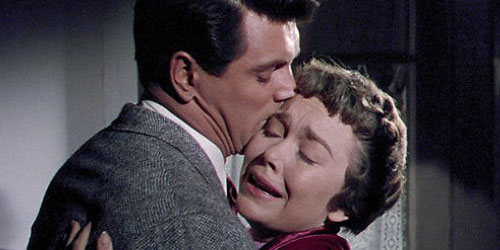
‘And now, to think Bob Merrick is alive because of Dad’s resuscitator.’
— Magnificent Obsession, 1954
That was the line. From then on, utterances of ‘the resuscitator’ became increasingly hilarious (and contagious), and if we’d known that when I hit Play Movie, we could’ve made an efficient little drinking game out of it. Eric became an ad-libbing machine, sending his mom and me into fits of laughter to the point that we may have missed a few instances of ‘the resuscitator.’
It doesn’t really matter how the resuscitator serves the plot. It was a super-soaper MacGuffin, and if you haven’t seen the movie, maybe the less said about its context the better (except that it’s freaking hysterical). A third of the way in, the resuscitator recedes, but the plot absurdities keep piling on (which I won’t spoil, much) and there are countless little treasures of subtext, style, and detail that make it the standard-bearer (as far as I’m concerned) of good/bad ’50s melodrama.
There’s the kooky pop philosophy behind Rock Hudson’s overnight conversion from rich asshole to aspiring surgeon/savior, a creed that combines the hokey altruism of Pay It Forward with the wackadoo determinism of The Secret, except that the catchphrase that comes with it — ‘I’ve used it all up’ — makes no sense whatsoever.
There’s the scenes where Jane Wyman, recently blinded in an accident, flies all the way to Zurich to be examined by a team of surgeons, whose world-renowned diagnostic technique consists of shining a penlight in her eyes and inquiring about dizziness.
There’s the awkward cutaways to poor Agnes Moorehead, whose Emotions-Color-Wheel face lets us know it’s sad that Jane Wyman’s husband dropped dead of a heart attack or worrisome that Wyman’s medical condition is uncertain.
There’s the parade of doctors and patients lighting cigarettes, fun in the admittedly cheap enlightened-hindsight way that it’s fun to watch Mad Men.
There’s the fuck-it transition where Rock Hudson talks about enrolling in med school one moment and the next — literally within a single dissolve — is hailed as a brilliantly promising brain surgeon in a newspaper clipping.
The list goes on. (It really does.)
But I thought the two stars were great. My mother-in-law Diane didn’t think much of Jane Wyman as Rock Hudson’s love interest, and I admit they seem like a pretty odd pairing at first. But I tell you what: Hudson really made me believe he was madly in love with the older, kinda schoolmarmish, confusingly coiffed Wyman — his real-life sexuality never got in the way of him seeming genuinely hot for his female leads, from what I’ve seen — and in her understated, dignified way she clearly wants to bag his bones, as any red-blooded American repressed lady would. Personally, I admired Wyman’s ladylike poise and kindness of spirit, and there’s something really serene about her face and carriage, even if she‘s criminally underserved by her stylist. Anyway, however mismatched they may seem now, they apparently lit the screen on fire in 1954 because Douglas Sirk paired them again the following year in All That Heaven Allows (a better movie in most ways but not as much fun).
Other good things. The super-saturated cinematography (a Sirk hallmark) is gorgeous to look at, even though too much of it is wasted on boring hospital rooms, offices, and corridors. The score is appropriately soupy but incorporates some legit themes from Beethoven and Chopin, a great combination of middlebrow and highbrow (exactly what I wanted). And it clocks in at a perfect 108 minutes. It was a thoroughly satisfying movie-watching experience. Go rent it with someone you love!
 make me a drink
What a information of un-ambiguity and preserveness
of precious knowledge concerning unpredicted emotions.