The fatal error of Pretty in Pink isn’t, as some people insist, that Andie (Molly Ringwald) ends up with the bland Blaine (Andrew McCarthy) instead of the dynamic Duckie (Jon Cryer). A lot of hay was made about the fact that the original, pro-Duckie ending was ditched for one that market-tested more favorably, and for a minute in the ’80s, the movie exemplified the sacrifice of good cinematic storytelling to the lowest common denominator.
But the truth is, both Duckie and Blaine are all wrong for Andie, and this is a casting problem, and by the time the filmmakers realized there was a casting problem it was probably too late. (John Hughes wrote the movie and Howard Deutsch directed it.) The choice between McCarthy’s mouse-faced boringness and Cryer’s kid-brother neediness was pretty much unnavigable. McCarthy may have failed to produce any sparks with Ringwald, but the chemistry Cryer generated was deadly for being so fraternal; focus groups probably responded to the original ending the way you or I might respond to Marsha giving Peter the eye.
The real flaw — the tragic flaw — of this movie is John Hughes’s mistreatment of Andie’s older coworker Iona (Annie Potts), one of the most magnetic, lovable, and fun-to-look-at characters of any romantic comedy. She looks like this.
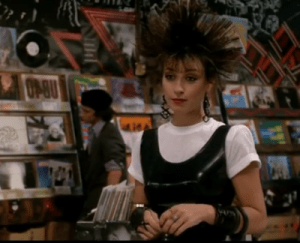
And this.
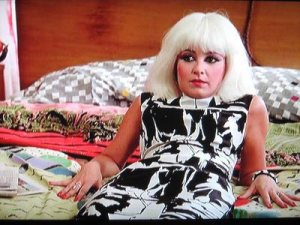
And this.
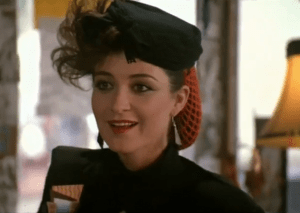
And this.

Right? Dazzling. But if we’re to believe this movie, she spends night after night alone, flopped out on her half-collapsed bed listening to old records and mooning over her glory days. Because evidently there are zero men in the entire Chicago metropolitan area who might be interested in a thirty-something woman who’s beautiful, fun, effervescent, and a genius of self-invention. It’s the self-invention part that’s the problem. The whole self-invention thing has to go — it’s messing up Iona’s chances of finding a husband! And in Hughes’ world, being unmarried, childless, of modest means, and nearing middle age is just about the worst fate imaginable. So he decides it’s time for Iona to get normal. He presents her with a Flock of Seagulls haircut, a yuppie wardrobe, and — ta-DA! — a boyfriend. A divorced doctor with kids.
Maybe you don’t remember how bad this is.
I hesitate to show it to you…
I can’t even…
Well, here it is.
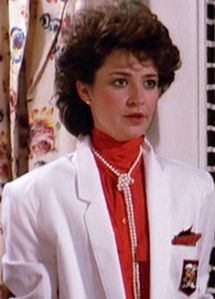
I was 14 when this movie came out, and I remember thinking: No. And: Why?
But Iona’s boldly suburban new style wins Andie’s unqualified praise, to which Iona self-deprecates, “Aw, I look like a mother.” Andie replies, “Well, a little. But that’s OK.”
See, but it’s not OK. Leaving aside the obvious horribleness of this look — whatever, it was the ’80s, we all went astray — it seems clear there’s no going back for Iona. She’s accepted this mainstreaming and filing-down of her persona as the cost of finding love. John Hughes has turned her into a high-functioning Stepford wife and we’re supposed to be happy about it.
Hughes had kind of a thing for overhauling his ladies, and Iona is reminiscent of his previous makeover victim, The Breakfast Club‘s Allison (Ally Sheedy), an artistic social misfit who wipes away her (entirely appropriate) goth eyeliner, tames her Chrissie Hynde hair under a nice, neat headband, and submits herself to the approving gaze of the Jock. The Jock! Who has precisely nothing in common with her. But oddball chicks need a stabilizing masculine influence, you see, someone like a doctor or a high school football star who can confer a bit of civilizing status and bring them into the fold.
Hughes’ conservatism has been chewed over and over and over; less discussed is this paternalistic streak of his, which extended even to characters in their goddamn thirties. He created genuinely interesting female characters and then couldn’t stop himself from overcorrecting them. Like a dad, he couldn’t let them pursue a path he thought unwholesome, couldn’t brook their autonomy, couldn’t permit them to explore another side of themselves with a social inferior (see Claire and John Bender in The Breakfast Club).
Like a dad, he just wanted us, the girl viewers coming of age in the ’80s, to turn out normal. He just wanted to protect us. And like a dad, he disappointed us all the more for how much we needed him.
 make me a drink
I never saw this! surprising cause I had a girlfriend at the time who liked these movies and dragged me out to several of them, I would make deals with her like “I’ll go to ’16 candles’ or breakfast club’ if you go to “clockwork orange” or “night of the living dead” oh brother. We agreed on rocky horror picture show at least.
I think that character is cute and certainly would have thought so at the time!