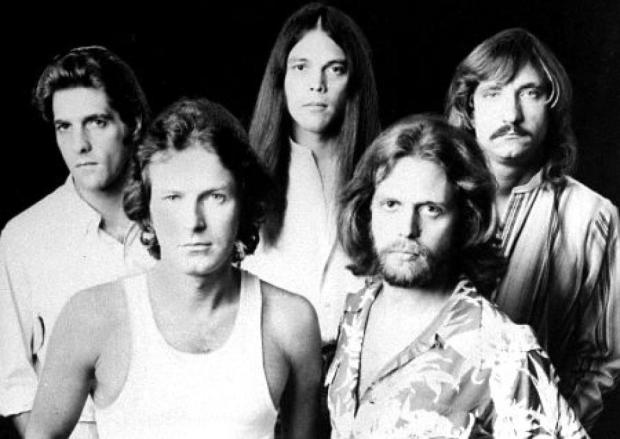
 Most people I know who are of a certain age and care about music in a certain way hate the Eagles. By ‘a certain way’ I mean (or I think I mean) that they’re much more likely to appreciate attitude, originality, and raw talent than technical skill or palatability. So they might say, for instance, that the Sonics were geniuses but the Doors were hacks. They might say Johnny Thunders ‘invented’ punk but Led Zeppelin ‘destroyed’ rock. They might think Sparks underrated and Rush overrated.
On the other hand, these people — let’s just go ahead and call them cool people — might support the revivalism of a previously overexposed-yet-widely-loathed act (e.g., the Bee Gees), or they might be an outright apologist for a piece of fluff like Neil Sedaka. But no one is defending the Eagles.
It is a fact that the Eagles have far surpassed Billy Joel in universal revulsion by cool people. I personally know at least two cool people who freely admit loving Billy Joel, and zero cool people who openly enjoy the Eagles. Quite a few Facebook friends of mine approvingly shared a news item about a woman who stabbed her roommate because he refused to stop playing the Eagles. (Typical comment: ‘Is that a crime???’)
And I get it — you cannot fucking get away from the Eagles. They’re everywhere. They’re on the front lines of rock’s corporate-backed invasion into the most banal spaces of our lives — supermarkets, family restaurants, your bank’s on-hold line. If you fall within a particular age range (and that range is probably broader than I think), you can never really ‘hear’ an Eagles song ever again. There is pretty much no way to evaluate an Eagles song.
So why do so many people insist they’re terrible? If the Eagles are terrible on their musical merits, I can’t figure out what makes them substantially different from the non-hated Byrds. If the Eagles are terrible because Don Henley and Glenn Frey are egomaniacal assholes (which seems to be the consensus), then it should be OK to hate Charlie Parker for such fairly repellent acts as stealing from his friends to buy heroin or getting a blowjob while eating chicken in the back of a taxi (according to the memoirs of Miles Davis, who was a wife beater).
(Yes, I know Don Henley is no Charlie Parker and Glenn Frey no Miles Davis. But you get the idea.)
Defending the Eagles, if that’s what I’m doing, is a really dumb task because they’re super-successful and it’s generally stupid and a waste of time to defend super-successful people. I don’t want to defend them so much as suggest that maybe it’s dishonest to hate a band we’re incapable of judging. Is ‘Hotel California’ a terrible song? I’m not sure. I only know I never want to hear it again. But let’s say, hypothetically, the Eagles never existed. And let’s say the marginal band Poco had an unreleased demo, and someone stole that demo from Richie Furay’s basement, and bootlegs of that demo got around, and that demo was ‘Hotel California.’ Would we like it? Again, I’m not sure. I think at least a few of the people who hate the Eagles might kind of like it. I think some of them might even share it on Facebook.
But who knows. We only have our experiences (and the sensibilities built on them), and it is bullshit that ‘there’s no accounting for taste’ because there absolutely is. I remember hearing ‘Hotel California’ as a 5- or 6-year-old, when it was first getting fuckloads of airplay, and being just fascinated. And even though I pictured the lyrics pretty literally — the beast at the banquet (in my mind’s eye it was a kind of fanged bull), the steely knives, etc. — I think I also had my first inkling of what a metaphor was.
My family was living in a Southern California suburb, it was the ‘70s (duh), and it seemed to be capturing something about that time and place…. the weather, certainly, and how it felt to ride in a car at night with the windows rolled down, and the soft-focus beauty that some women had. But besides that, I remember at that age finding a lot of things, a lot of people, profoundly creepy. I still feel that way about the ‘70s, but in a way that now kind of enthralls me and makes me want to seek out every artifact, every album, every Robert Altman movie: it was such a gloriously creepy decade! And though ‘Hotel California’ is definitely the worse for wear and no longer has much of an effect on me except mild irritation, at the time it kind of embodied that special creepiness for me. Which is why I can’t 100% get on board the Eagles hate train — for a minute there, they made a mark.
But maybe that was just my shitty 6-year-old taste.
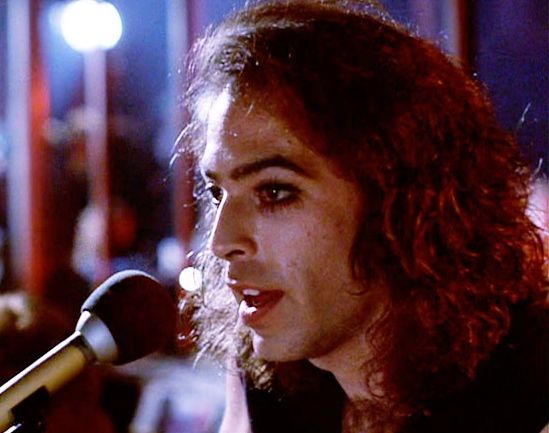 On the eve of Prince’s July 4th Essence Fest show (which I didn’t have tickets for), I rewatched Purple Rain with some friends and was thunderstruck anew by the sexy, magnetic, eyeliner-wearing star of the movie.
 make me a drink